Vocabulary Building Strategies
So many vocabulary building strategies fall short of the goal–creating readers, writers, and thinkers who can understand and communicate through powerful language. There are reliable (and simple!) alternatives to the easy and fruitless common practices.

Vocabulary Instruction Improves Comprehension When It Focuses On…
….which of the following?
- Groups of synonyms
- General academic vocabulary
- The difficult words from the text
- None of the above
If you guessed none of the above, you’re right! Vocabulary instruction improves comprehension when it focuses on a few academic vocabulary words that repeat across a group of texts (or within one longer text). Let’s clarify.
1. Groups of Synonyms
Research suggests that groups of synonyms are too closely related for students to internalize them. Learning ten different words for something can be extremely overwhelming. How is a student supposed to differentiate the shades of meaning? If a student previously knows a synonym, that can be helpful, or they can deepen their understanding of a target word through synonym study.
2. General Academic Vocabulary
These are typically fruitful words to teach, but there are a couple of issues with teaching a general list. First, there’s no guarantee of multiple exposure in print. Second, many of these words can be incidentally taught because students already hear them across their school day and understanding them will happen within classroom activity. For example, students will learn the word “analyze” by analyzing in class. I also guarantee by high school that they have had enough exposure to this word to not require direct instruction. What they are analyzing may be more complex, but that it the instructional need, not what analysis is.
3. Difficult Words from the Text
If you are teaching grade-level text to a less experienced group, this will quickly exhaust them. Just footnote the “one-off” words (or provide an image if it’s an object). In addition, I like allowing students to submit one word or question or idea after an independent read of a text. This lets them tell me which words they don’t know, which are often not words I would have anticipated. Many students tend to submit the same words, so this is also affirming for them.
A Better Approach
A few academic vocabulary words that repeat across a group of texts (or within one longer text) is a better approach because you can teach them deeply. You’ll never teach them all the words they “need to know.” In fact, they will not learn most words from you at all. They will learn them from conversation and reading and media. This approach requires greater intentionality, patience, and attention on the part of the teacher. It is well worth it.

Vocabulary Building Strategies
To identify the words (like three per week), you can
- use a knowledge-building curriculum that has pre-identified repeated words, like CommonLit
- read and identify the words yourself
Some people may consider AI to identify repeated academic vocabulary, but there are likely copyright issues with this approach. Dumping texts outside the public domain into AI violates fair use.
Introducing New Words
- I display a slide with a student-friendly definition (typically something I revised from Longman Dictionary). Include an image, but this can be more difficult with abstract words. Take the time to explain how you connected the image to its word and definition.
- Students record the word definition in their notebooks.
- I shut off the slide. In groups or independently, they can add synonyms they know and/or the word in their home language (if it’s not English).
- Independently, they draw a picture that represents what the word means to them.
- Students rate their understanding of the word.
Vocabulary Activities and Games
Two or three times a week, we do vocabulary activities and games. Build them into your daily routine. The options include
- Word study. Reading dictionary, etymology, or thesaurus resources and adding new knowledge to our notes.
- Usage practice. Discussion or writing practice using the words. This can be a longer task (paragraph or essay) as students demonstrate mastery.
- No-prep games that grow over time as a general review. Charades, pictionary, and Blooket. Quizlet is a great way to play live games but also print flashcards for speed games. There are also some great, quick Jeopardy! game-makers.
Vocabulary Intervention Strategies
A standard strategy is to rely on quizzes and retakes to provide vocabulary intervention strategies. However, these do not address the full Common Core Language Standard #6.
Acquire and use accurately general academic and domain-specific words and phrases, sufficient for reading, writing, speaking, and listening at the college and career readiness level; demonstrate independence in gathering vocabulary knowledge when considering a word or phrase important to comprehension or expression.
The first half emphasizes acquisition AND use across reading, writing, speaking, and listening domains. A quiz could do this, but with the activities above, it’s not necessary. The second half, demonstrating independence in gathering vocabulary knowledge, is also rarely part of a vocabulary quiz but evident through the earlier mentioned activities.

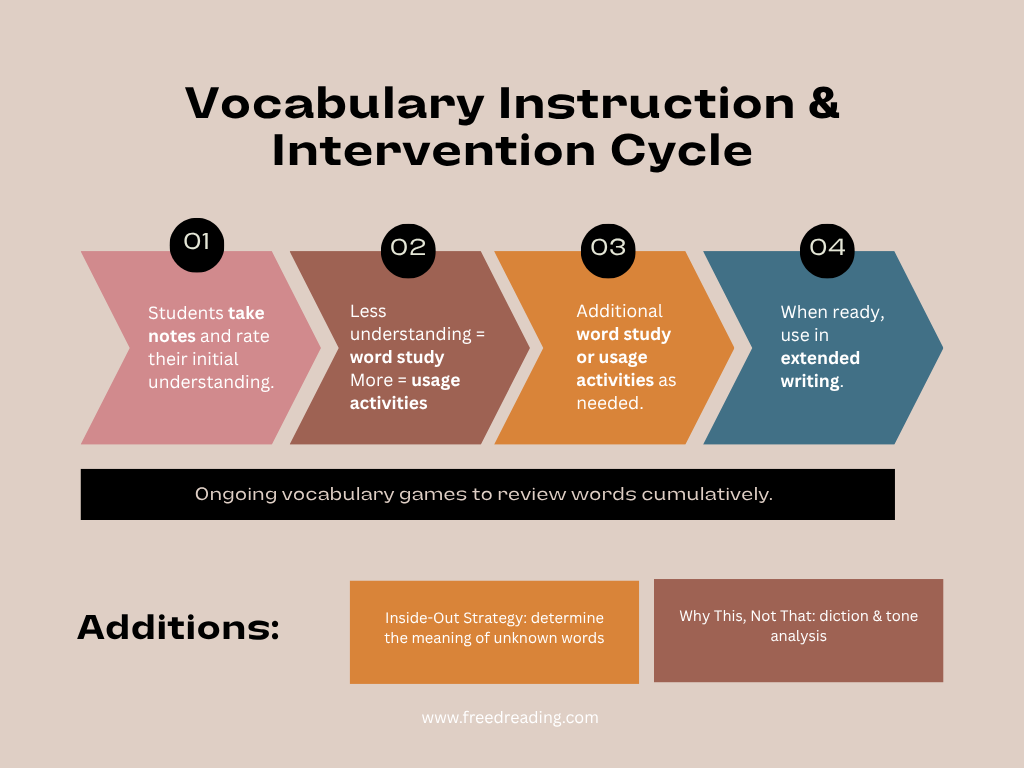
Vocabulary Instruction and Intervention Cycle
Here are the data points that give more information than a quiz:
- Student notebooks. Student self-ratings after the first notes tell you how ready they are to demonstrate use. This information helps me sort words into word study and usage activities.
- Games. While students play, pay attention to which ones are incorrect. Schedule them for more word study to help with retention.
- Word study. Review what students added to their notes. This lets you know if they can “independently gather knowledge.” Check that they updated their rating of the word. Decide on more word study or moving on to usage.
- Usage activities. Are they using the word correctly? Schedule a word study activity that will address the gap in understanding. If they have it, schedule the word for incorporation into an extended writing (paragraph or essay).
[Data sheet available in Vocabulary Building Strategies SUPERPACK]
Vocabulary Comprehension Strategies
In addition, vocabulary comprehension strategies include some other language standards of the Common Core. They focus on determining the meaning of unknown words, analyzing language’s impact, and making stylistic choices.
Vocabulary building strategies lay the foundation for this work.
Determining the Meaning of Unknown Words
Once students have practiced using reference materials, they can use them in independent practice in conjunction with the inside-out strategy that teaches students to incorporate context and synonyms given by the text. This strategy can be modeled during guided reading.
Analyzing Language’s Impact
My favorite way to do this is Hattie Maquire’s Why This, Not That strategy. We consider a word the author used, a synonym they could have used, and why they chose the one they did. This is also great prep for making stylistic choices.
Making Stylistic Choices
Once students demonstrate usage of a word, they can practice choosing a word or its synonym to fit the style and tone of what they are writing.
Vocabulary Building Strategies Superpack
Ready to implement vocabulary building strategies that transform readers and writers? This superpack includes comprehensive resources to teach vocabulary all year.
- Year-long student notebook for 108 words so students can review and retain word knowledge.
- Deck of vocabulary slide templates for note-taking (Canva and PowerPoint). Add your own words!
- 4 word study and usage activities to deepen student understanding.
- 6 game direction slides to get students interacting and reviewing words.
- An instructional decision-making data sheet to track student mastery and decide the next step.
- 2 additional activities for determining unknown words and analyzing language, complete with rubrics and instructional slides.