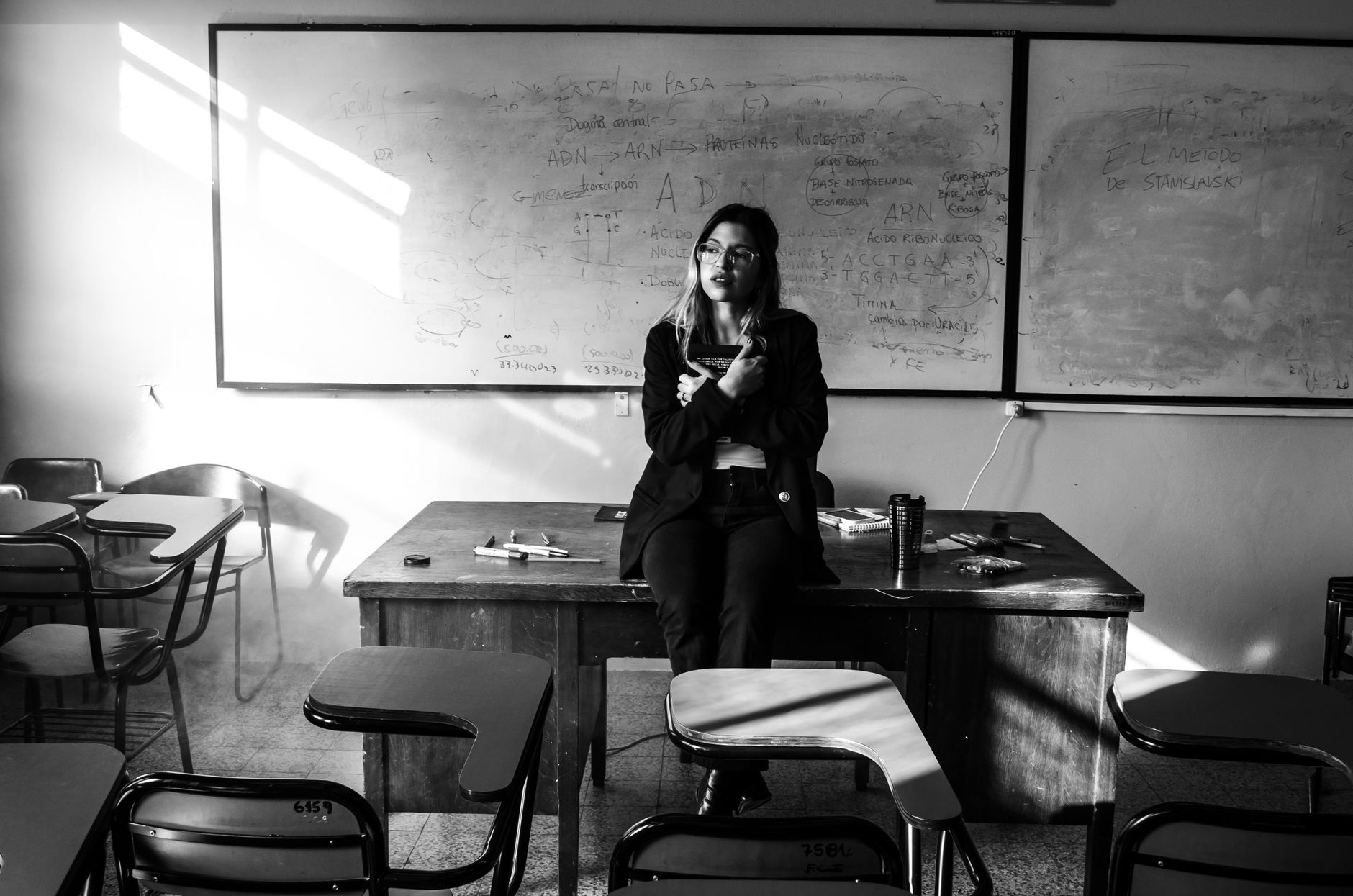
Analog Classroom
Yes, the Internet has informed me that analog is back. People are buying more physical media (or dragging it out of the basement) and setting down their phones (at least for a little while). I anticipate that this trend will continue to spike as AI sorts us into houses. So what does an analog classroom look like today?

Gather round, young ones. I started teaching in 2007, which was not a purely analog era, but boy does it seem analog compared with today! There were DVDs and a projector with transparencies. We went to the computer lab when we needed to type something or use the World Wide Web (or need AC, because it was the only room in the school with air conditioning). Texting was the worst cell phone misbehavior, and it rarely happened. A cell phone policy was unnecessary. Although they existed, none of my students had a smartphone (nor did I). For those of you with analog memories, remember them, share them. The future may depend on us analog ancestors.
Reclaiming Analog Teaching
After 19 years, I see teaching as a continual process of reclaiming what’s important and shedding what’s not. Here are three concepts I want to reclaim in analog teaching.
1. Metacognition
Let’s return to learning as a process. The digital approach tends to short-circuit reflection (or assume it’s already there). Sadly, many students don’t see school as a place to learn, but a place to know. You either know or you don’t. To emphasize learning, I’m bringing back goal-setting and reflection (and adding meetings during advisory time for goal review).

I also heard recently about retrieval practice, and I want to be more intentional with that.
By using paper lesson plans and notebooks, I can be more reflective of my own practice too.
2. Multi-Sensory Experiences
Analog teaching is all about multi-sensory experiences. Schools, which have always struggled to be multi-sensory given their institutional nature, need it now more than ever, since there is no guarantee of students living a multi-sensory life outside of school.
- More notebooks and paper books. It’s not that copies and digital texts will go completely to the wayside. I teach ELA to English Learners! They (and many other students) benefit from assistive tech like graphic organizers and audio–but these can be used in such a way to augment multi-sensory experiences.
- More anchor charts. I’ve wanted to do this for years, but I always fall back on my bloated slide deck! I want a few lovely anchor charts to let the environment do the teaching.
- Fewer slides. I rely on my slides to help me keep 3 different classes straight and provide routine structure. When I started teaching, I did those things without slides. I’m not ready to cut the cord completely, but I don’t want to be chained to my computer. I don’t like glorifying the glowing rectangle of my whiteboard as the class focal point. What can we do instead? Face each other. Move around the room. Use the school’s outdoor classroom.
- More plants and music. I already have a lot of puzzles, games, and coloring books, along with lamps in my analog classroom, but plants and music are two things I under-utilize to create a multi-sensory experience.
- More taste. I don’t actually mean food (though I am a big fan of having mini water-bottles on hand for students, especially for that afternoon slump!). ELA is an area for taste development. What do you like? What don’t you like? What’s your style? What’s your identity? In other words, what’s your resonance?
3. Resonance
Sociologist Harmut Rosa has developed a theory of resonance to explain some of what’s lacking in the current world. People are feeling more alienated than ever, Rosa claims, due to a lack of resonance. Resonance is the sense that you matter and impact the world around you. In the analog classroom, this could be key to attendance as chronic absenteeism persists post-COVID. Here is how I want to develop resonance.
- Resonant literature. Of course I believe that I have chosen great works for us to read, but is it resonating with students? Are they aware that literature can resonate? It’s my job to pull on the threads of resonance to help students find them.
- Harkness discussions. This is a student-centered discussion technique where students drive the focus. This creates resonance because students’s participation matters. If the teacher is driving the discussion, the individual respondents matter less. Harkness emphasizes that every student’s unique perspective is valuable. I have just started venturing out with Harkness discussions. Here are tools from Philips Exeter, where the method originated. I also love Tan Huynh’s adaptations for English Learners.
- Choice. In addition to choosing where to take discussion, students can choose reading materials and writing projects. Choice is resonant because it allows students to impact their experience in the classroom.
- Classroom jobs. Some students will take longer to feel resonant with the content of the class, but for them, a classroom job reinforces that they matter to the space and the people in it. (I have some classroom jobs in this resource, but I want to add more)
- Advisory. As mentioned earlier, I want to bring in more goal-setting and metacognition. When I meet with students about their goals, I can seek what resonates for them. Maybe a student feels disconnect from the content but reveals a resonant goal that I can emphasize in the classroom. In addition, I want some one-on-one time with students. I have some now, and it is always difficult when there are many people in the room, but I can be more intentional.
What’s your analog teaching?
I’m still in the thinking phase on this, and I would love to know: What are your favorite analog techniques? Are you bringing anything back that you’ve discarded? Younger teachers, what resonates for you in this? I’m on Instagram @freedreading.