
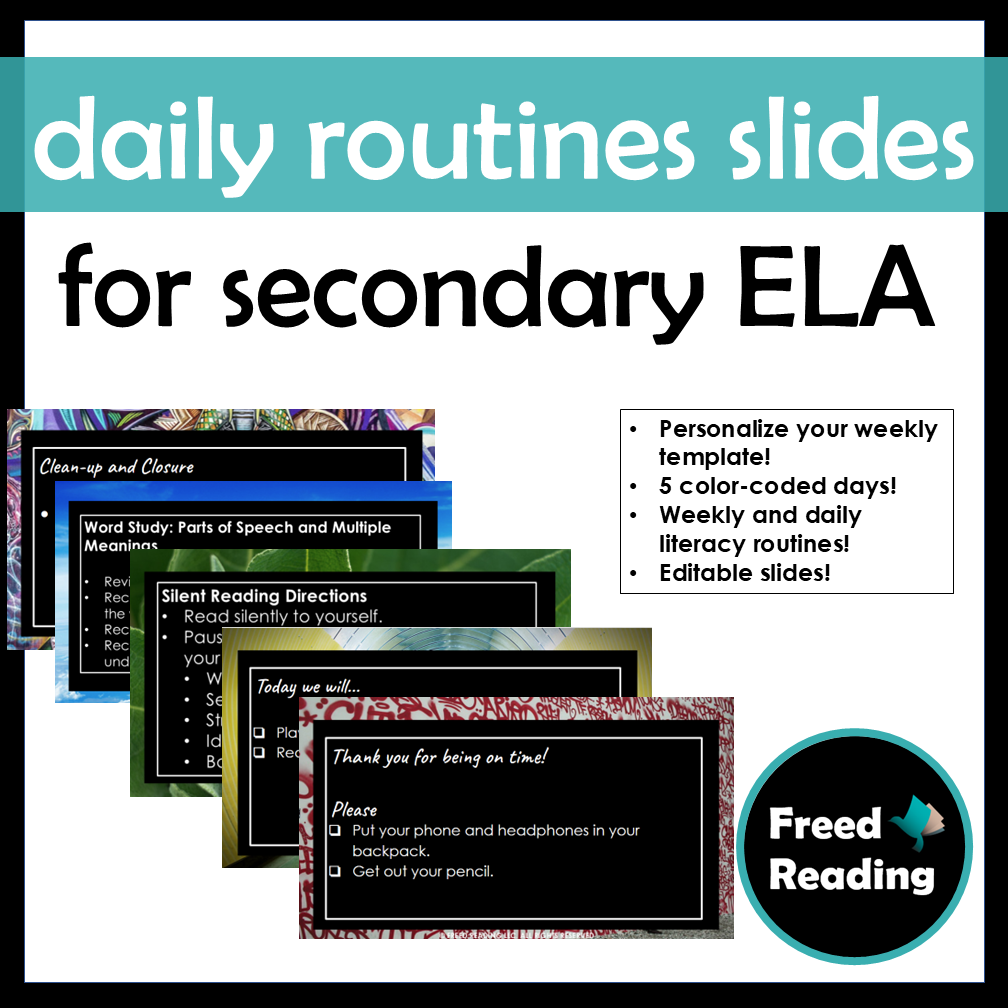
Daily Routine Slides
Who creates the most content? Not the daily news. Not a Tik Tok influencer. It’s teachers. We create daily routine slides, assignments, lectures, activities, curriculum, data spreadsheets, and family newsletters. The school year is a treadmill of content creation, and you can’t adjust the speed.

You might have mixed feelings about all the content creation. Some of it is fun. It connects you with your students and your purpose. Some of it is repetitive and needlessly time-consuming. This is how I feel about daily routine slides. Why not make more time for the fun stuff and put daily routine slides on autopilot?
Daily Routine Goals
There are several goals for daily routine slides:
- reinforce the 4 moves every literacy lesson needs
- keep the priorities consistent
- communicate expectations
- provide a safe, predictable environment
- reduce your decision fatigue
Daily Classroom Schedule
Every classroom is different, but here is the flow that is working for me right now in a 50-minute period.
- Welcome and get out materials
- Review learning objectives
- Vocabulary or writing instruction
- Reading instruction (read, discuss, and write about a common text)
- Studio or café (if time)
- Clean-up and closure
Weekly Lesson Plan Form
Within this daily routine, there are several variations for days of the week.

Example of Daily Routines
Vocabulary
I am experimenting with Robert Marzano’s six-step vocabulary framework. I’ve heard that it is effective, so this is my experimental year. My hope is that my daily routine slides will keep me faithful to the task. I will be teaching 3 words from our common text each week. I’m selecting academic words that repeat themselves across the various texts in a unit (or are repeated within a longer text).
Reading Instruction
Reading instruction is a broad label. Here are the parts:
- A very short introduction to the text. Any context or background knowledge that the text does not explain or setting a purpose for students’ reading.
- Reading. They follow along while I read, read silently, or choose between listening to an audio and silent reading. The method depends on complexity, time of year, and ability of the group. If the reading is at or above grade level, I read aloud to them (though I may do this less as the year progresses). If it is slightly below, they can choose. If it is significantly below, it’s silent reading.
- Discussion. I use questions either during a read-aloud or after to check for understanding. Sometimes we discuss as a whole class, sometimes small groups, sometimes with partners. If they have been partnered or grouped for a vocabulary activity that day, they work with those same peers in discussion. Otherwise, we stick together. Ideally, in a circle.
Writing Instruction
Most writing instruction is linked to reading instruction. This year, I am experimenting with the Hochman Method. At the end of each reading lesson, I will do a sentence-level writing activity. On Wednesdays, we will do a paragraph- or essay-level writing activity to go with the reading. This is my general plan. There may be times where I suspend the daily routine slides to give us more time for writing.

Studio and Café
These are independent practice activities. I had so many students last year give me feedback that they wanted more time to write for pleasure, so I am letting students choose to write or read during studio time. I will provide ideas and books that relate to the class topic for students who struggle with independence. Many teachers like 10 or 20 required minutes at the start of class, but I want to make the time length flexible. That way, I can speed up or slow down reading and writing instruction as needed in the moment.
Café is my Friday component. It’s a time for students to share about what they are reading or writing. We will mix up partners, small groups, and whole class. I like it as a way to build community and practice speaking and listening.
Daily Routines Games
There are several places to infuse daily routine games. For vocabulary, I love no-prep games like charades, pictionary, and Blooket. Quizlet is a great way to play live games but also print flashcards for speed games. There are also some great, quick Jeopardy! game-makers.
You can turn discussion into a game too. I like using an UNO-style game. With multiple choice questions, you can make an escape room or play secret wager. In this game, groups start with 100 points. They make a secret wager, then hear a question. I have them answer on a whiteboard. The winning groups add their wager to their total. The others subtract it. If this is too complicated, whiteboards with small groups and tallying how many each group gets right also works. (For even more discussion ideas, check out How to Make Magic with the Class Discussion Teaching Strategy).
For writing, I’ve done relay races or brought in humor. Students can write funny sentences or paragraphs or write about funny images or videos.
My Daily Routine Slides
Put daily routine slides on auto-pilot with Daily Routine Slides for Secondary ELA. No more endless copying and pasting or hunting for that “one slide.” Save time for what really matters while keeping the priorities consistent.
This resource includes
- Directions for making your slides faster than ever.
- 5 color-coded days (so you don’t even have to change the date!)
- Weekly and daily routines to consistently build literacy skills
- Vocabulary routines for introduction and review
- Reading directions
- Discussion expectations
- Editable opening, objective, and closing slides that you can copy and paste to make more personalized slides



[…] or three times a week, we do vocabulary activities and games. Build them into your daily routine. The options […]